



Why and how to manage your recovery time after exercise?
Recovery is an essential part of sport. Whatever the sport, it is important to manage your recovery time properly to improve your performance and prevent injuries.
In this article, we explain why it is important to manage your recovery time properly after exercise. Also discover our tips for optimising your muscle recovery process and boosting your performance.
Respecting your recovery time after exercise: essential for athletes
Recovery is just as important as training for athletes who want to progress in their sport and improve their performance.
They are two essential ingredients for making effective progress. The key to success is finding the right balance between training time and recovery time.
The importance of recovery after exercise
Whatever the sport, you need to expose your body and muscles to a certain amount of strain to improve your performance.
During physical exertion that puts heavy strain on the muscles, micro-traumas form in them. After exercise, the body needs a certain amount of recovery time to allow the muscles to adapt and repair. Over time, the muscles become more resilient and stronger after each recovery phase.
Athletes who neglect the muscle recovery phase therefore do not progress as quickly. Their muscles simply do not have time to rebuild and grow stronger.
It is also important to point out that a lack of recovery can lead to serious muscle injuries that are difficult to treat.
Passive recovery and active recovery: what are the differences?
There are two types of recovery: passive recovery and active recovery.
Passive recovery
Passive recovery involves a longer or shorter period of rest. During this time, it is essential to keep intense physical exertion to a minimum so that the muscles can recover.
While some athletes opt for just one rest day a week, others prefer to rest every two or three days. This choice depends on many factors, such as the athlete's fitness level, the sport practised or the intensity of the training sessions.
Active recovery
Active recovery, on the other hand, consists of doing low-intensity physical activity after intense exertion. Very popular with athletes, active recovery helps eliminate toxins by improving blood circulation.
Cycling, walking, swimming and yoga are some examples of activities suited to safe and effective active recovery.
Our tips for optimising recovery time after exercise
The ideal recovery time after exercise varies from person to person. Certain factors, such as training intensity, the sport practised or the athlete's level of fatigue, affect how long the recovery phase lasts.
Here are some tips and good habits to help you optimise your recovery time after exercise:
- Do stretching exercises right after exercise : stretching is particularly effective at easing muscle tension and optimising blood circulation,
- Drink enough water before, during and after exercise : good hydration is essential for the body to function properly. For muscle recovery, hydration helps eliminate toxins and carries essential nutrients and oxygen to the muscles,
- Massage the muscles you have used : massage reduces muscle tension and optimises blood circulation. The muscles are less painful and recover more quickly. However, do not massage an area of the muscle that suddenly became painful during exercise,
- Eat a healthy, balanced diet : eating well is also essential for athletes. It is important to provide all the nutrients the body needs to function. For recovery, it is recommended to eat enough carbohydrates to replenish energy stores and enough protein to optimise the muscle recovery process.
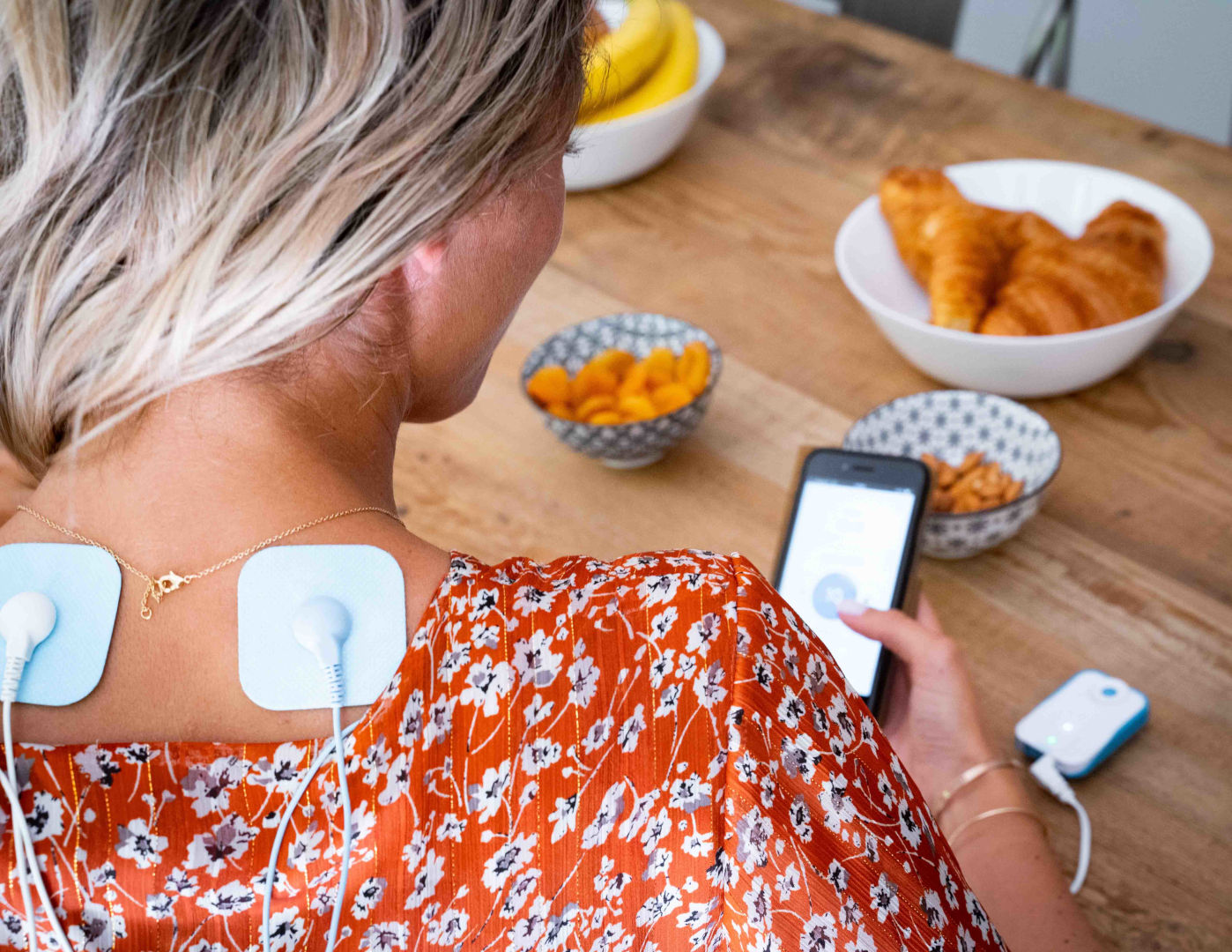
Electrostimulation: a natural and effective method for recovering better after exercise
Electrostimulation is a natural method used for therapeutic purposes and to improve comfort and well-being.
It produces controlled alternating muscle contraction and relaxation using low-intensity electrical impulses. The natural process of muscle contraction, normally controlled by the brain, is reproduced almost identically by electrostimulation.
For many years, electrostimulation has been recognised for its effectiveness in soothing pain, relaxing and strengthening muscles.
The benefits of electrostimulation on recovery time after sport
Electrostimulation has a positive impact on recovery time after exercise in several ways:
- Muscle tension is reduced thanks to the massage and relaxation of the targeted muscles, which promotes blood drainage from the muscle,
- Waste and toxins are more easily eliminated from the body thanks to better blood circulation,
- Damaged muscle fibres heal more quickly,
- Pain felt during the recovery phase is reduced.
Electrostimulation therefore allows athletes of all levels to recover faster and get back to training more quickly. Discover the testimonials and reviews of top-level athletes who use Bluetens to train in the best conditions.
Optimising your muscle recovery time with Bluetens
Bluetens offers many electrostimulation programmes developed by a team of sports enthusiasts and healthcare professionals. Users can easily choose the programme they want and the body area to target using a dedicated, intuitive app.
Here are two Bluetens programmes to use to optimise your recovery time after exercise in a completely safe and effective way.
The “Active recovery” programme
The “Active recovery” programme is designed to improve blood flow and optimise the removal of waste during the recovery phase after exercise. The lactic acid in the blood is eliminated more quickly than with purely passive recovery based on rest.
This programme can be accessed from the “Single session” section on the home page of the Bluetens app. Choose the “Relax” option and the body area to target. Then select the “Active recovery” programme in the “Sports activities” section.
The “Intense recovery” programme
The “Intense recovery” programme is specifically designed to optimise the regeneration of your muscles after exercise. Muscle pain is relieved and the muscles repair more quickly.
To access it, go to the “Single session” section, choose the “Relax” option and the body area of your choice. Then select the “Intense recovery” programme in the “Sports activities” section.
Posted in: Active recovery
Related posts
-
 Tout ce que vous devez savoir sur la récupération activeIl existe plusieurs façons de récupérer après un effort sportif : faire des étirements, se reposer ou encore...Read article
- La récupération active : un atout indéniable pour la musculationLa récupération active est une pratique sportive qui consiste à réaliser une activité physique de faible intensité...Read article
- Comment faire une séance de récupération active en football ?Pour récupérer après un match de foot, il existe deux principales méthodes : la récupération passive et la...Read article
- Comment pratiquer la récupération active grâce au running ?Si vous êtes adepte de la course à pied, il est possible de mêler activité physique et récupération en même temps....Read article
- Cyclisme : comment faire une séance de récupération active efficace ?Tous les cyclistes le savent : une bonne récupération physique est la clé du succès de tout entraînement. Il existe...Read article